
The user is transferred a copy of the data for direct analysis.
Sensitive health data is distributed across hospitals, research institutions, and national boundaries and data protection law increasingly restricts how it can be moved. Data federation addresses this by allowing researchers to analyse data without accessing it directly. This page explains the approach, the technology, and how the Aridhia DRE supports federation from metadata discovery through to governed analysis and output.
Data federation enables researchers to analyse sensitive data without granting them direct access to the dataset. Instead, they can use approved federated data analysis tools to perform their research without transferring the data.
When a research project is granted access to sensitive data, it is common for a copy of the data to be transferred to a trusted research environment. In this instance, researchers are able to view the full dataset and perform their analysis on it directly. Where direct sharing of data is not possible due to security restrictions and/or data protection laws users need an alternative way to analyse the data.

Federated Data Analysis means that rather than granting researchers direct access to view record level data and perform analysis, they are granted federated access permissions to send approved analytics to the data source and run remote tasks, only receiving aggregate results. This means that sensitive data doesn’t have to be shared to be analysed, making use of it in a compliant and secure manner.
A paper highlighting the potential of using federated analysis networks to provide access to previously inaccessible datasets for research.
Data protection laws like GDPR make data sharing across national borders and institutional boundaries increasingly difficult, restricting the ability of researchers to share data with colleagues outside of their organisation. Federated Data Sharing allows researchers to analyse data that they cannot access directly.
Pioneering data federation solutions for life sciences and healthcare industry leaders has led us to develop an open source tool for handling federated analysis tasks. That tool is The Federated Node.
The Federated Node (FN) is an open source software component built for running federated tasks, and was the first product available under the Aridhia Open Source GitHub organisation.
The Federated Node is built on three existing projects:
The Common API was developed in 2021 as an open standard for data platforms to participate in data sharing networks. It specifies a set of endpoints that provide a framework for organisations that wish to collaborate on federated data sharing and analysis. It provides the structure of the Federated Node API.
Keycloak is used for token and user management, and nginx is used as a reverse proxy, to route incoming requests.
Federated Node deployments are lightweight and use common technologies. All Federated Nodes are deployed to a Kubernetes cluster and require a Postgres database for storing user credentials.
A deployed Federated Node must be associated with a Docker container registry which is used to store the remote tasks that are run against the data. This architecture gives the data owner full control over what code is run against their data, as only scripts stored in the associated container registry can be used, and only authenticated users have the ability to initiate federated tasks.
If you would like our assistance in joining or creating a federated network using the Federated Node we are happy to offer consultancy support.
You can learn more about our setup support service here.
This licence ensures that the Federated Node is free to use, that the source code can be modified and distributed as needed, and that any subsequent projects based on the FN must also be open-source.
The use of a federated data platform for conducting federated analysis presents data networks and consortia with an attractive solution for sharing data while remaining GDPR compliant. Read the PHEMS case study below to learn how Aridhia is providing federated data analysis tools to facilitate compliant data sharing between hospitals.
PHEMS (short for “Paediatric Hospitals as European drivers for multi-party computation and synthetic data generation capabilities across clinical specialities and data types”) is a Europe-wide consortium of paediatric hospitals with the aim of revolutionizing the way in which critical health data is managed and utilized across Europe.
Born from the need for a GDPR-compliant solution to sharing data that also takes into account the complex data protection legislation requirements of working across differing jurisdictions, PHEMS is working with Aridhia to provide a federated data network that will allow the partners to collaborate across national borders.

In the first episode of Trusted Research Conversations, we sit down with Chong Shen Ng, Research Engineer at Flower Labs, to explore how federated learning is changing what's possible in health data research.
Listen NowDelivering real world federated analysis solutions, the Aridhia DRE is giving data owners and researchers new tools to securely share patient data in order to conduct vital medical research.
Aridhia's DARE UK TREvolution final report: federated TRE workspace integration, GA4GH Task Execution Service implementation, and Federated Node development.
This interim report details initial work carried out by Aridhia under the DARE UK TREvolution project.
Aridhia shows DRE workspaces can act as federated infrastructure and plans organisational FN ownership in 2026 to enable scalable, self‑service data federation.
Aridhia releases Federated Node V1.0, a lightweight, secure, standards‑based tool for federated analysis with Git integration and broad database support.
This whitepaper covers the concept of data federation within a trusted research environment by using the example of Aridhia’s work with the PHEMS consortium.
Running federated tasks is only one part of a federation workflow. Data owners need to make datasets discoverable, manage access requests, and issue credentials securely. Researchers need a governed environment to submit queries and work with results. The Aridhia DRE connects these steps into a single, auditable workflow built around the Federated Node.
The Federated Node is just part of a data federation workflow focussed on running federated taks and not an entire end-to-end product. As a trusted research environment, the Aridhia DRE integrates with the Federated Node to provide features like a metadata catalogue, data access request management (DAR), and a UI for submitting federated analysis tasks and viewing the results after they have been run.
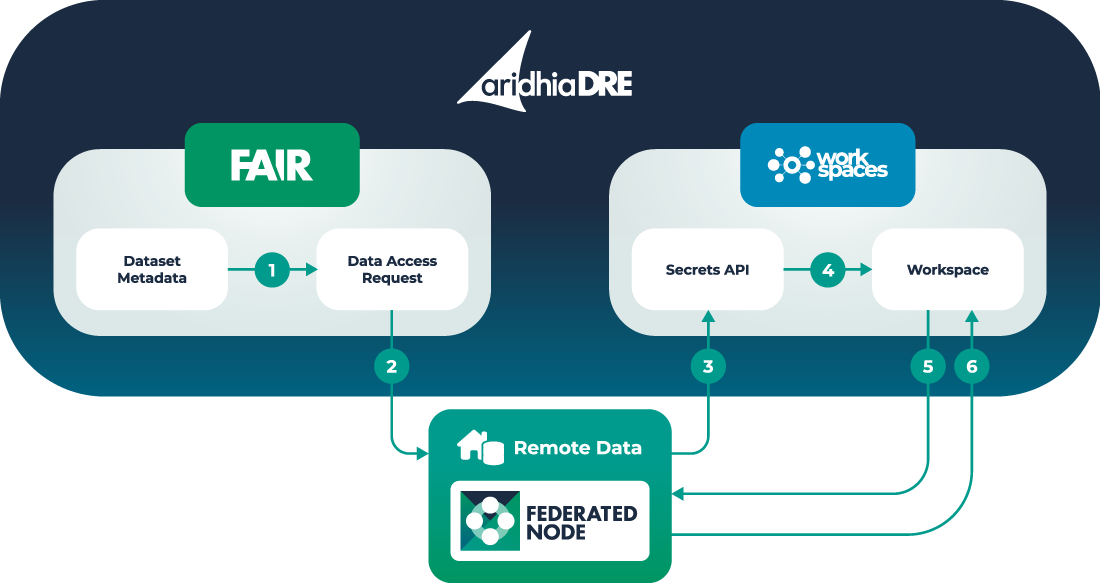
FAIR Data Services within the Aridhia DRE, allows data owners to self-serve connections to data deployed with a Federated Node and associate it with dataset metadata. This feature also ensures secure generation and transfer of user authentication tokens into Workspaces.
The benefits of querying a Federated Node from a secure Aridhia workspace include providing research teams with a powerful, easy-to-use user interface and the deployment of custom applications for carrying out federated analysis requests and visualising the returned results.
A TRE with federated analysis capabilities built in, the Aridhia DRE is the platform giving data owners and patients peace of mind that their data is being used for research securely.