
PHEMS: Building a European Federated Data Sharing Network
This is the first blog in a two-part series where we reflect on Aridhia's involvement in the PHEMS and EPND projects over the past four years. Both projects are multi-national, EU-backed collaborations focused on improving access to research data, and both have had positive outcomes. Both are now coming to their conclusion.
In the first blog we look at PHEMS, its objectives and outcomes, and Aridhia's contribution to the project. We also reflect on the lessons from PHEMS which will be applicable to the European Health Data Space (EHDS).
What is PHEMS?
PHEMS is a collaboration between four leading European children's hospitals and industry partners. The primary objective of the PHEMS project was to create a federated data sharing network that can be used by the four founding hospitals to collaborate on rare disease research. This would initially support three use cases covering a mixture of federated analytics and federated learning projects:
The post-project objectives are to expand the number of network members and use cases, with a long-term goal of making the network's data and federation capabilities available to third parties.
What was Aridhia's contribution?
Aridhia's primary contribution to the project was the development of the Federated Node (FN). The FN is an open source data federation project based on the GA4GH Task Execution Service (TES). Along with a central GitHub project used to store the analytical code and initiate tasks, the FN is one of two key components of the PHEMS network:
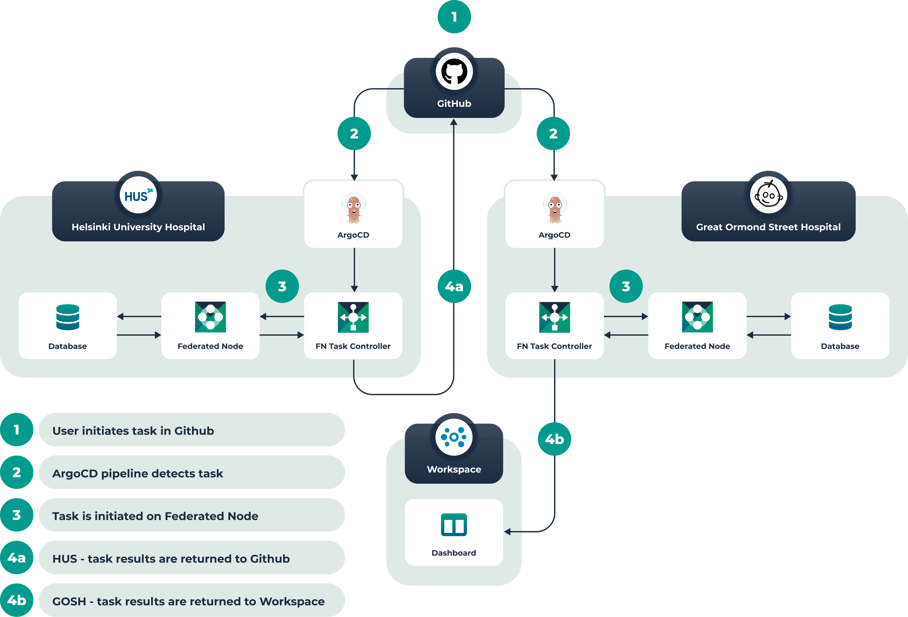
In addition, Aridhia has helped develop the audits and controls framework for the network, and we are currently assisting with onboarding new network members.
What were the project outcomes?
PHEMS has achieved a number of important outcomes:
- The network now has a production ready federated benchmarking capability allowing network members to compare their performance across clinical outcomes
- Additionally we have run federated learning use cases across the network and proved that federated learning capabilities can be fully integrated with a Trusted Research Environment (TRE)
- From a governance perspective PHEMS has developed a playbook for creating, running and maintaining a federated network
Lessons for the EHDS: the importance of standards
The federated approach taken by PHEMS is not directly applicable to EHDS, however, as a pan-European collaboration between health data holders there are still lessons to be learned.
PHEMS has highlighted the importance of common standards for large-scale, cross-border, data collaboration. This has manifested in a number of places, from the adoption of OMOP as the data model for all use cases, deploying common software in the Federated Node, and adopting common practices and procedures from the playbook and the audits and controls frameworks.
The success of EHDS will depend heavily on these sorts of agreements. A common vocabulary, shared standards and well understood processes and procedures will all be required.